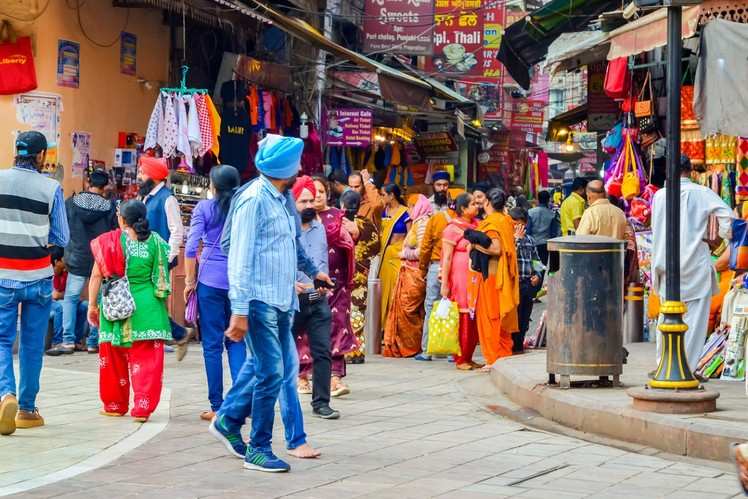
The air hits you first—not gently, not gradually, but all at once. You step off the train at Amritsar Junction and walk straight into cardamom-thick warmth, the smell of mustard oil and somewhere, always somewhere, incense burning. It's 5:45 in the morning. The city is already awake in a way that feels almost unfair to people who sleep. Cycle rickshaws are honking themselves to life. A man in a checked turban is arguing with a vegetable seller about the price of okra with the intensity of someone negotiating nuclear treaties. Two teenagers on a Hero Honda scooter are racing a stray dog, and the dog, inexplicably, is winning. Nobody tells you this part: Amritsar isn't asking for your approval. It's simply existing, loudly, messily, completely itself—and somewhere between the chaos and the chai and the sound of a thousand conversations overlapping, you realize you're exactly where you need to be.
The Golden Temple announces itself the way lightning does. You round a corner near Jallianwala Bagh, and there it is—the Harmandir Sahib rising out of the Sarovar like something between a dream and a claim that cannot be denied. But here's what the photographs miss: it's not the gold that changes you. It's the people. Three months ago, I sat by the temple langar—the free kitchen that feeds 100,000 people daily—and watched a woman in her seventies, wearing a faded dupatta, serve dal to a businessman in a three-piece suit, a street child, and a tourist from Germany, all with the same unhurried grace. When I asked her, in my fumbling Punjabi, why the langar existed, she smiled like I'd asked the silliest question in the world. 'Because,' she said, 'when you walk into Gurudwara, rich or poor doesn't matter. Everyone eats the same, sits the same, prays the same.' That's Amritsar's actual religion—not the faith itself, but the stubborn insistence that human dignity is not negotiable. The Temple exists because the founder, Guru Arjan Dev, believed that spirituality wasn't something that belonged in marble and mountains—it belonged in the middle of the city, feeding people, right now, in this life.
The best meal of my last visit wasn't in any restaurant. It was on a plastic stool outside Kanha Sweets, at 11 pm on a Tuesday, eating something called kulcha—a bread the size of your face, stuffed with chickpeas and served with aloo sabzi that had been simmering in a wok since morning. The kulcha man, whose name I never got, had oil-stained fingers and the ability to slap dough onto the side of a tandoor and catch it perfectly crispy without looking. He was listening to a cricket match on a transistor radio older than I am. When I asked why he didn't expand, open a 'proper restaurant,' he looked at me the way you'd look at someone who suggested you relocate your heart to a different city. 'Why would I?' he asked. 'People know where to find me. I know every person who comes. My Rohit sits here after school and does homework. What restaurant gives you that?' That's when you understand—Amritsar isn't trying to optimize. It's trying to stay real. Walk around the Hall Bazaar early enough and you'll see the same vendors in the same spots they've occupied for thirty years, selling everything from fresh turmeric to knockoff iPhones, calling out prices in that particular Punjab rhythm that sounds like a song if you let it.

Let's be honest: the first thing every guidebook tells you about Wagah Border will mislead you. Yes, the ceremony is theatrical. Yes, there are Indian soldiers kicking their legs up to their chests while screaming like they're personally settling a grudge with Pakistan. Yes, it's aggressively performative. And yes, you absolutely should go—but go understanding what you're actually watching. It's not war. It's ritual. It's two nations who genuinely dislike each other, twice a day, agreeing to shake hands at the end anyway. The local men—the ones who've seen this a hundred times—told me the real magic happens after the barriers drop, when soldiers on both sides nod at each other. That small nod contains decades of shared border, shared weather, shared humanity that refuses to disappear despite every reason it should. Go in the late afternoon when the sun is lower, when it's less crowded, when you can actually see the expressions on soldiers' faces. And wear closed shoes—trust me on this. The frontier is genuinely dusty, and you will see things that don't make sense (there's always someone in an inappropriate outfit), but that confusion is the point. Amritsar sits on a border between nations, between religions, between the ancient and the aggressively modern, and it's made peace with the contradiction. You should too.
There's a moment, usually around 6 am when you're walking toward the Temple for the first time, when the city is quiet enough that you can hear the water moving in the Sarovar—the sacred pool—and the bells haven't started screaming yet, and there's just this soft, ancient sound of ritual continuing, the way it has for four centuries. That's when Amritsar stops being loud and becomes luminous. The marble around the Temple glows gold-orange in the early light. Pigeons are everywhere, and locals are pouring milk and grains for them like an offering. A woman dips fully into the pool, completely submerged, then comes up laughing—actually laughing—like she's been baptized into something her tired face needed. An old man in white sits cross-legged and simply watches the Temple, his lips moving in prayer so quiet you can barely hear it. This is the Amritsar the postcards can't touch. Not because it's serene—that word is a lie—but because it's genuinely full of something. You can feel the weight of four hundred years of devotion in that pool. You can feel the weight of every person who has ever believed, deeply and without question, that this place matters. And the thing that gets you, the thing that brings you back three years later even though you swore you wouldn't, is that they're right. It does matter. Not because the gold is beautiful, though it is. It matters because belief, when it's this honest and this stubborn, is contagious.

On my last morning, I was sitting in a gurdwara (a Sikh temple—there are dozens scattered across the city, each one a smaller, quieter version of the main Temple) eating a simple breakfast of poori-sabzi, listening to the raag (morning prayer song, a kind of devotional music that sounds like the voice of the city itself), when the man next to me asked where I was from. When I said Delhi, he nodded knowingly. 'You'll come back,' he said. Not as a question. A statement. 'Everyone does. Because Amritsar doesn't let go. You think you come to see the Temple, but really, the Temple comes to see you.' I thought he was being poetic. I was wrong. Months later, sitting in a Delhi traffic jam, I'll suddenly smell mustard oil or hear a siren that sounds like a bell, and I'm back there—in the chaos, in the gold, in the strange peace of a city that has decided that being fully, loudly itself is its greatest strength. Amritsar does that. It gets into your chest and stays there, quiet and persistent, like a prayer you didn't know you needed.