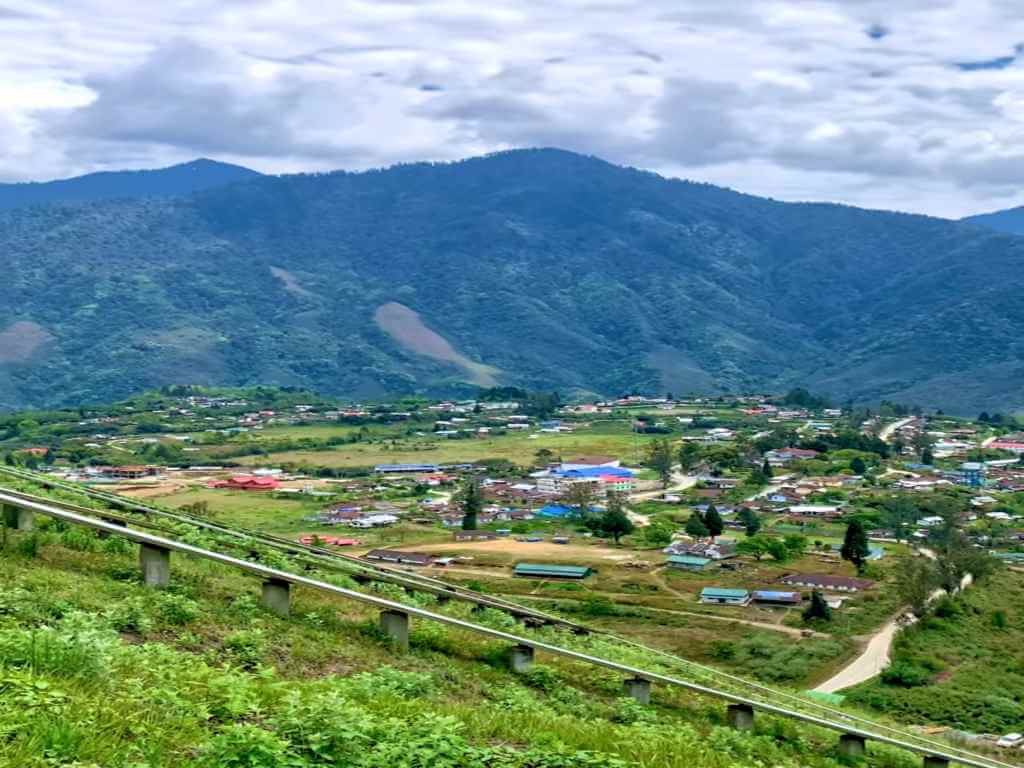
Nobody warns you about the silence. Every story you have heard about the Northeast mentions the green — relentless, aggressive, almost indignant green — but nobody tells you that in Anini, the district headquarters of Dibang Valley, the silence is so complete at six in the morning that you can hear the Dibang River thinking. The mist sits low over the pine ridges like it has nowhere else to be. The light, when it finally comes, arrives in long amber rods through the treeline, turning the dew on the grass into something a jeweller might charge for. There are no horns. No chai stalls cranking up their generators. No WhatsApp notifications — not because you have switched off your phone, but because the network has made that decision for you, firmly, without apology. You stand outside your guesthouse in a fleece you thought was adequate and realise immediately that it is not, and somehow, weirdly, you are glad about all of it.
Anini sits in the Dibang Valley, home of the Idu Mishmi people — one of the smallest indigenous communities in India, numbering fewer than twelve thousand, who have somehow preserved a relationship with this land so intricate it makes the word 'indigenous' feel insufficient. The Idu Mishmi have a practice they call igu — a shamanic ritual in which a priest mediates between the human world and the spirit world of animals, forests, and rivers. I sat one evening with Raju Mimi, a retired schoolteacher who had spent thirty years documenting Idu oral histories in a spiral-bound notebook he kept wrapped in a plastic bag, and he told me something I have been turning over ever since: the Idu Mishmi do not separate conservation from cosmology. To hunt a certain species without ritual permission from the spirits is not just culturally wrong — it is understood as a rupture in the fabric of things. It is why the Dibang Valley has some of the most intact old-growth forest in all of South Asia. Not because of a government order. Because of a worldview.

The market in Anini is the size of a large living room and operates on a logic all its own. On the mornings when the supply truck has made it up from Roing — a journey of roughly two hundred and fifteen kilometres that can take anywhere between eight and fourteen hours depending on the road's mood — the market briefly resembles a celebration. Local women in their distinctive Idu Mishmi shawls, woven in deep reds and blacks with geometric precision that would make a Bauhaus designer weep, sell smoked pork wrapped in leaf, dried bamboo shoot, and a fermented rice beer called apong that tastes like a very sincere handshake. I once had a meal of boiled yam with chilli paste and river fish cooked in a hollowed bamboo section over firewood, sitting on a wooden bench while a dog of unclear allegiances watched me with the focused attention of a food critic. It was the best thing I ate that entire trip. I have tried to recreate it at home three times. I have failed magnificently each time.
Here is what most visitors to Anini get wrong: they come for a weekend. Anini does not reveal itself in a weekend. It takes at least three full days before the place stops feeling like an ordeal and starts feeling like a conversation. Also, and I say this with love, sort out your Inner Line Permit before you leave home — without it, you are not getting past the checkpost, full stop. The only road in is the one from Roing, and in monsoon, that road is less a road and more a suggestion. October through April is when you want to come: the skies are clear, the Dibang runs a spectacular glacial blue, and the forest trails are dry enough to actually walk without auditioning for a mud-wrestling competition. Do not expect five-star anything. The guesthouses are clean, basic, and run by people who will feed you better than most restaurants in Delhi if you simply ask what they are cooking for themselves.

What saves Anini from feeling remote in the wrong way is the wildlife — or rather, the knowledge that the wildlife is there, watching, even when you cannot see it. The Dibang Valley is one of the last places in India where you might plausibly spot a red panda, a clouded leopard, a golden cat, or a Mishmi takin — a creature that looks like someone designed an animal by committee, part bovine, part mountain goat, entirely magnificent. I did not see a clouded leopard. I want to be very clear about that. I did see pugmarks on a trail near the Mehao Wildlife Sanctuary boundary that made my guide go very quiet and then suggest, in the calm tone of someone who has given this advice before, that we walk back now, slowly, talking loudly as we went. The forest here is the kind that has intentions. You walk through it feeling less like a visitor and more like a guest who has not quite been vetted yet.
There is a word the Idu Mishmi use — emüng — roughly translated as the feeling of belonging to a place the way a river belongs to its valley. Not ownership. Not nostalgia. Something older and more mutual than both. I thought about emüng a lot on my last morning in Anini, sitting on the concrete steps of the Circuit House at five-forty-five, watching the Dibang catch the first light, a cup of tea going cold in my hands because I kept forgetting to drink it. I had been there four days. My boots were wrecked, my rain jacket had given up on its waterproofing ambitions, and I had fourteen unanswered messages waiting the moment I got signal back. None of that felt like the real world yet. Anini was. That is the specific kind of dislocation this valley leaves you with — not the disorientation of being lost, but the disorientation of having been, briefly and completely, found.
Back in Mumbai, three weeks later, I opened a work email and found myself thinking about the sound of the Dibang at night — that low, constant hum, the river carrying itself somewhere with total commitment. Anini does not let you Instagram your way through it. It asks more than that, and it gives back accordingly. If this has sparked something in you, the team at Dream Destiny Trips has a tendency to turn these sparks into actual itineraries — reach out and watch what happens.