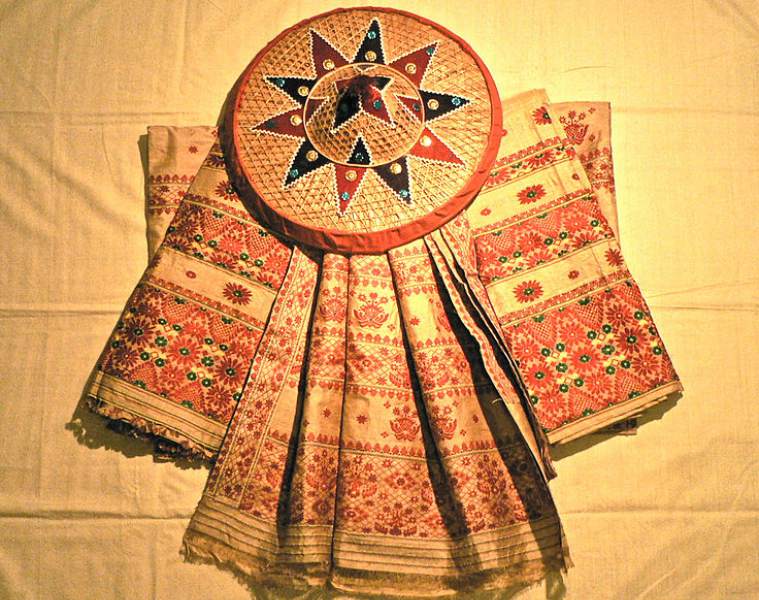
The Brahmaputra hits you first—not as an idea, but as an actual fact of geography that your lungs understand before your brain does. You step off the bus into air so thick with river moisture and wood smoke that it feels less like breathing and more like inhaling a memory. The water moves past the ghats with the kind of casual enormousness that only truly large rivers possess, brown and hypnotic, carrying stories from the Himalayas down to Bangladesh and beyond. It is barely six in the morning, and the city is already moving—fishermen in boats that look constructed from prayer and optimism, women in mekhela chadors (the traditional wrapped skirt, pronounced meh-KAY-la, worn by Assamese women) descending the stone steps with clay pots, the occasional temple bell cutting through the humid air like someone's grandmother is reminding everyone that devotion doesn't sleep. You realize very quickly that Guwahati is not a city that asks permission. It simply is, in all its chaotic, spiritual, unapologetically human glory.
Kamakhya Temple rises above the river on Nilachal Hill like an argument with the sky, its terracotta-coloured dome repeating itself across the centuries. But the temple's real story—the one that makes locals pause and speak more quietly—isn't about architecture. It's about bleeding. The temple is one of Hinduism's most sacred sites, dedicated to Kamakhya, the goddess of fertility, and particularly to a festival called Ambubachi, which celebrates the menstruation of the goddess. During these four days in June, the temple closes completely. Pilgrims come from across India to receive blessed cloth that has soaked up water from the sanctum—a ritual so counterculturally direct about menstruation that it makes most modern conversations about periods look timid by comparison. When I first heard about this, sitting in a small dhaba (roadside eatery) near the temple gates with a local journalist named Priyanka, she laughed at my surprise. 'We've been doing this for centuries,' she said, dipping her luchi (fried bread) into spiced potato curry. 'The rest of the world is still figuring out that blood isn't dirty. We already knew.' Standing inside the sanctum later, feeling the cool stone beneath bare feet and the weight of a thousand years of women claiming their own bodies as sacred—that changed something in how I understood what devotion actually means.
Find yourself at Guwahati's street markets around seven in the morning, and you'll understand why people describe food as a language. The Fancy Bazaar (yes, that's the actual name, a colonial leftover that somehow stuck) smells like turmeric root, fresh coriander, and the particular sharpness of mustard oil heating in a thousand small pans. Order jera aloo—potatoes spiced with just cumin, salt, and that same mustard oil—from any vendor with a permanent stall, and you will eat something that tastes like breakfast has tasted here for five hundred years. But the real reveal is luchi-alur dum: fluffy fried bread with a curried potato filling so perfectly balanced between spice and comfort that it erases the distinction between street food and temple offering. There's a vendor named Ramesh who's been at his corner stall for thirty-two years; his hands move with the kind of precision that comes from muscle memory and love. When I fumbled my Bengali asking for an extra portion, he simply smiled and packed double, refusing money with a gesture that meant something like 'your hunger matters more than my profit.' That's the texture of daily life here—transaction as small kindness, food as conversation, the market as proof that a city's real character lives in how it feeds strangers.
Here's what tourists get wrong: they arrive expecting Guwahati to be a launching point to somewhere else—Meghalaya, the Northeast hill stations, the tea gardens. And yes, it serves that purpose. But treating it as a waypoint is like skipping the opening chapter of a book you're about to read. The weather is unambiguous; if you come between December and February, you'll get the clearest air and the least rain, and the Brahmaputra will feel almost contemplative. But if you want to understand what water means to this city—what the monsoon actually teaches—come in July or August, when the sky empties itself daily and the river swells to a size that makes you understand why ancient people worshipped it. Avoid the Ambubachi festival if you're looking for quiet temple time, not because there's anything wrong with crowds, but because the crowds are here for something sacred that has nothing to do with your itinerary. And for the love of chai, don't order it in your hotel. Go to any street corner at 5 PM and watch what 'tea pe charcha'—gossip over tea—actually means: this is where real information lives, where business deals happen, where city consensus forms. The guesthouse WiFi will be temperamental. A five-hour bus ride might stretch to seven. But every honest inconvenience is payment for something true.
The Brahmaputra Islands—there are actually dozens, some inhabited, some turning wild—demand their own kind of attention. Majuli, the largest, is shrinking every year as the river claims it grain by grain, which gives the place an urgency that sadness can't quite capture. The Sattriya dance tradition (a classical form developed in the region's vaishnavite monasteries called sattras) still lives here in specific communities, taught to children the way other communities teach swimming, a thread of continuity being passed down while the actual ground beneath these monasteries erodes. Taking a ferry across the river—the water the colour of strong chai, moving with intention—changes your scale. For forty minutes, you are not a tourist in a city. You are a person crossing a river, which is much older work. The islands feel temporal in a way that unsettles your sense of permanence; you understand, standing on riverbank soil that might not exist in a decade, why ancient philosophies here developed such clarity about impermanence. The locals on Majuli move with a different rhythm—slower, more rooted in the particular drama of living on land that is literally disappearing. There's no rushing on Majuli. The river won't permit it.
What stays with you after leaving Guwahati—what pulls you back on quiet evenings in your city—is the specific texture of a place that doesn't perform for visitors. The 'selfie tourists' you'll see at Kamakhya Temple are real, yes, but they exist in a completely different spatial universe from the women who visit for Ambubachi, who understand this pilgrimage as something written into their own bodies. The traffic is genuinely chaotic (bus conductors here have opinions about your life choices and will share them freely). The humidity makes your clothes stick to your skin like a second, perspiring consciousness. The river floods, the city adapts. Monsoons come, the landscape becomes half-water, and nobody treats it as a disaster because it isn't one—it's just how things work here. What Guwahati teaches you, if you stay long enough to listen, is that devotion and dysfunction aren't opposites. A place can be simultaneously disorganized and sacred, difficult and generous, temporary and eternal. The Brahmaputra carries everything downstream and nobody can stop it, and somehow the city has learned to love it anyway. That seems like the most honest kind of wisdom available.
If this place has sparked something in you—that particular longing that comes from meeting a city on its own terms, not yours—the team at Dream Destiny Trips has a tendency to turn these sparks into actual itineraries. They understand that Guwahati isn't on the standard tourist circuit, and that's precisely why it matters. Reach out to them, tell them what pulled at you in these words, and watch what happens. They'll build you something real.