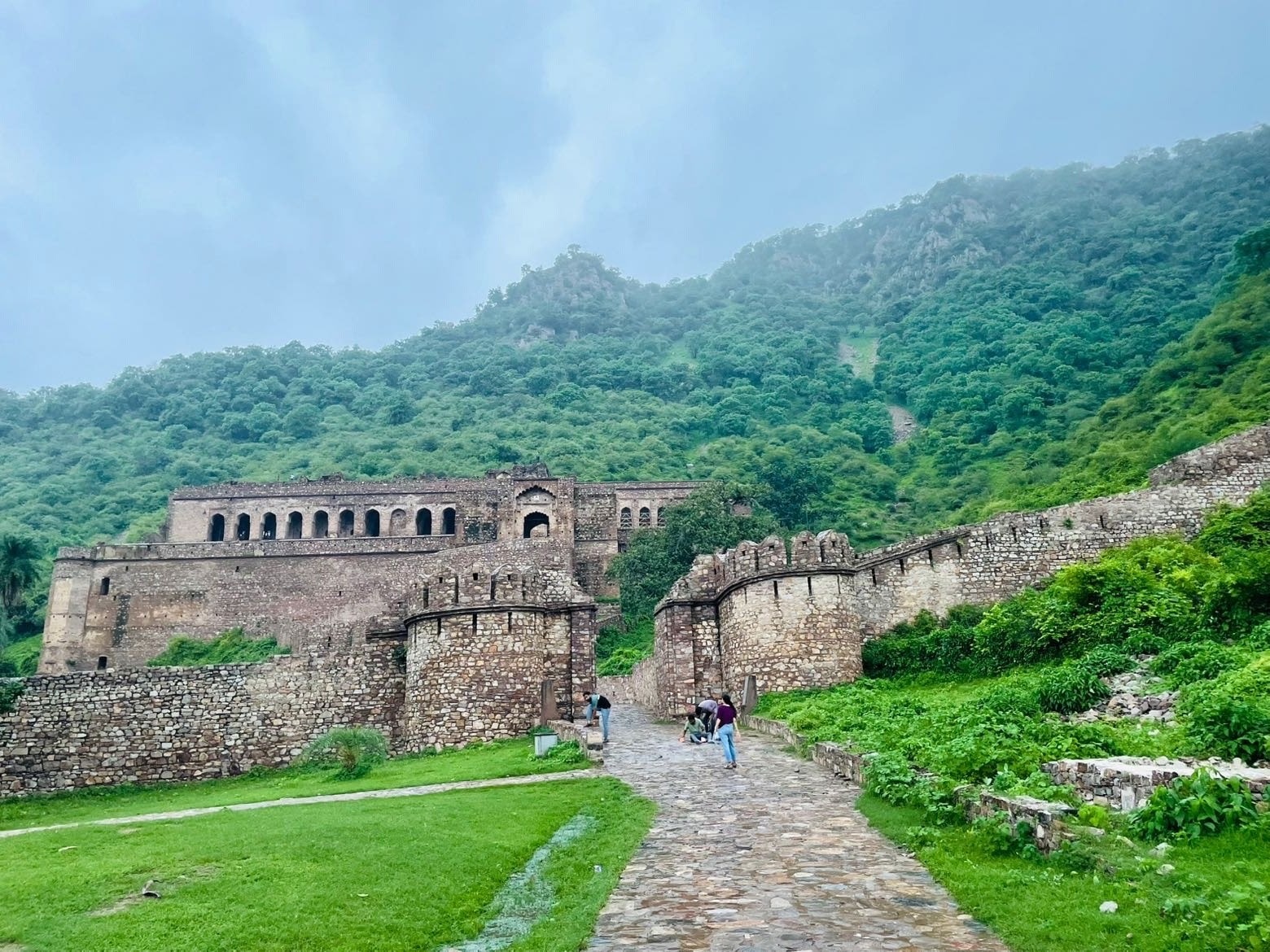
The bus groans to a stop outside the walled city just as the call to prayer echoes across the rooftops—five notes that feel older than time itself, layering over the sound of bicycle bells and someone's phone playing tinny Bollywood music. You step down into air thick with dust and diesel, and for a moment everything is confusion: auto-rickshaw drivers shouting, a goat wandering across the street wearing a bell that sounds like it's announcing arrivals at a very small, very confused heaven, and everywhere—everywhere—this peculiar golden light that makes even the concrete look like it's been touched by wealth. The fort rises above it all, not imposing exactly, but present. Patient. Like it's been waiting for someone to finally sit still long enough to listen to what it has to say. Within ten minutes you'll realize your phone signal has become sporadic and nobody seems to think this is a problem. Within twenty, you'll understand why.
The fort's real story lives in the havelis—those carved sandstone mansions where merchant families once stored salt and opium and the kind of money that built empires. Patwon Ki Haveli sits near the eastern gate, five storeys of intricate jali screens and pillars carved so intricately you wonder if the craftsmen ever left, or if they simply became part of the stone. A local guide named Rajesh (everyone's guide is named Rajesh, and somehow this feels intentional) once told me these aren't just houses—they're the autobiography of ambition written in stone. Families spent generations adding details to outdo their neighbours, each jali screen a boast, each pillar a whispered "look what I could afford." But here's what stays with you: many of these families abandoned their havelis decades ago, moving to Mumbai or Delhi or London, and now the buildings stand with their stories slowly disappearing into the mortar. You'll find old photographs pinned to walls—grainy black-and-white images of people in formal dress, standing in courtyards that no longer know laughter. It's not sad, exactly. It's the way all beautiful things eventually become monuments to themselves.
The real food of Jaisalmer doesn't happen in restaurants; it happens in the gaps between things. There's a stall near the clock tower run by a woman named Lakshmi who makes gatte ki sabzi—spiced gram flour dumplings in a yoghurt-based curry—that tastes like someone's grandmother decided to cook comfort itself into a dish. The spice hits first, then comes the cooling yoghurt, then the texture of the gatte that crumbles slightly between your teeth. It costs maybe fifty rupees. Around dusk, chai pe charcha—gossip over tea—happens on the steps near the main gate, and if you sit with a cup for long enough, you'll hear stories: about the monsoon that flooded the fort in '92, about the tourist who hired a camel and rode into the desert alone only to come back three hours later asking if anyone had seen his sunglasses. Local people argue with surprising passion about whether the water here is truly sweet or if visitors just imagine it because they're so thirsty. They're probably right.

Here's what nobody tells you: the fort gets uncomfortably crowded between 10am and 4pm, and the guesthouses that promise "rooftop views of the sunset" often share those roofs with forty other people all trying to take the same photograph. Go early instead—5am early—when it's just you and the old sweeper and the light doing something extraordinary to the stone. Also, the camel safaris that promise "authentic desert experiences" are mostly authentic in their ability to make your legs numb for three days afterward, which is authentic in a technical sense. If you must go, do it in November or early December when the temperature won't actively hate you. Skip the mainstream desert camps; they're designed for Instagram and serve chai that tastes like it was brewed in 2019. And when someone offers you something "special," ask what it is first. I learned this after accidentally agreeing to eat something called "desert rat curry," which is precisely what it sounds like and absolutely not what your body expects.
There's a particular moment around 6pm when the fort shifts from place to story. The light turns soft and amber, and the sandstone starts glowing from within, as if all those centuries of prayers and footsteps and carved wishes have accumulated into actual luminescence. You'll find yourself walking the narrow lanes with no destination, just following the light and the shadows it creates. The old city within the fort walls still has residents—families who've lived here for generations—and you'll see women in brilliant coloured ghagras hanging laundry from windows carved with intricate screens, see children chasing each other through passages so tight two people can barely pass. It's not a museum that happens to have people; it's a living city that happens to be very old. This distinction matters. The people aren't performing for tourists. They're living, and tourists are just passing through.
The desert itself—Sam or Khuri, depending which way you venture—teaches a kind of patience that most of us have forgotten. You sit on a dune as the sun moves lower, and the sand turns colours that don't have names in any language you know: ochre bleeding into magenta, magenta bleeding into violet, violet finally giving up and becoming black. A camel herder will sit nearby, not saying much, and you'll realize that silence in a place like this isn't empty—it's full of things we've learned to ignore in cities. Wind. The sound of your own breath. The crunch of sand under shifting weight. The way your mind, when it's finally quiet enough, starts asking questions you've been avoiding for years. Sunrises here hit different too. The cold is sharp—this is the part nobody mentions in the brochures, how truly cold the desert gets—and you'll stand shivering while the sky turns from purple to orange to a gold that matches the fort walls back in the city, and you'll understand, finally, why anyone ever decided to build something permanent in the middle of nowhere.

When you leave—and you will leave, possibly reluctant, definitely changed—Jaisalmer doesn't let go easily. You'll find yourself thinking about the light at odd moments: while waiting for the metro, sitting in a meeting, trying to fall asleep in your air-conditioned bedroom. You'll crave chai the way it tastes here, though no place else will quite manage it. You'll remember the sound of the call to prayer better than you remember most conversations. There's a quality to places like this—places that haven't been entirely absorbed by commerce, that still contain actual silence—that rewires something fundamental. You don't come back from Jaisalmer with photographs. You come back haunted by the idea that time moves differently in places where buildings are still older than systems, where stories matter more than schedules. If this has sparked something in you, the team at Dream Destiny Trips has a tendency to turn these sparks into actual itineraries—reach out and watch what happens. They understand that some journeys aren't about collecting destinations; they're about finding places that collect you.