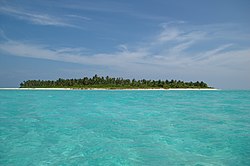
The boat cuts through water so clear you can watch your shadow on the sand thirty feet below. You're standing at the bow with a cup of chai going cold in your hands—not because the tea isn't good, but because you've stopped moving long enough to actually notice the colour of the water: not blue, not green, but some colour that doesn't have a name in English, only in the Malayalam spoken by the boatman who keeps glancing back at you with the patient expression of someone who has watched a thousand mainlanders realize they've been living in black and white. The air tastes of salt and coconut husk. There's no engine noise. Just the slap of waves and the occasional call of a tern. You haven't seen another tourist boat in two hours. This is Lakshadweep, and it doesn't care if you've heard of it.
The real introduction to this place comes not from the guidebook but from Hassan, who runs the guesthouse in Agatti and whose grandfather was one of the last traditional pilots—navigators who read the stars and the shape of waves the way you read a map. Hassan pours you another chai and tells you about the monsoon season when the whole archipelago would shut down, when the British thought the islands were cursed because nothing moved, nothing arrived. 'But we knew,' he says, tapping the side of his head, 'the sea was just talking to us. Telling us to stay still.' His grandfather would climb to the highest coconut tree and watch the horizon for changes in light that took hours to reveal themselves—weather patterns three days away, visible only to someone patient enough to wait. That philosophy of listening rather than demanding has seeped into the bones of these islands. When you stop trying to conquer them, they start to show you things.

You stumble into the best meal of your life by accident—a small stall near the Agatti jetty run by a woman named Aisha who makes tuna biryani only on Wednesdays, which you learn by asking wrong and then asking right and then coming back the next day anyway. The rice catches just enough of the coconut milk to have a faint sweetness, and the tuna flakes apart with the gentleness of something that's been treated with respect. She refuses payment the first time you come back, which feels like an insult until you realize it's an invitation. The next time you return—and there will be a next time—you sit on a plastic stool and listen to her describe the difference between fish caught at dawn and fish caught at noon, how the meat changes with what the tide has fed them. The locals call this 'para chuthachu'—evening conversation—and it happens everywhere, in shops and on boats and in these tiny food stalls where the real news of the islands actually travels.
Here's what nobody tells you: the permits are a genuine hassle. You need permission to visit most islands, and the bureaucracy is exactly as inefficient as you'd imagine Indian bureaucracy to be—forms that require forms, authorities who insist they don't know about a rule they literally just quoted. Don't fight it. Hire a local guide for two days; they'll navigate this like a monsoon tide. Also, forget about luxury. The guesthouses are clean and honest, but 'air conditioning' sometimes means a window. The WiFi, when it exists, moves at speeds that would embarrass a dial-up modem. Bring books. Bring patience. Visit between October and April—after April, the heat becomes almost cruel, and the monsoon brings a beauty that's more for locals than tourists. And when someone invites you for tea, you go. Period. That's not optional. That's how you actually see something real.
The coral here is still alive in places—though less than it was even five years ago, which Hassan mentions quietly, without making it a tragedy, just a fact that sits between you both like something heavy. You take a boat to a lagoon where you can snorkel, and a young guide named Rashid shows you a section of reef that's recovering, where the fish are returning. He points out a clownfish that's made a home in a particular anemone, 'same one, three years now,' he says. On the way back, as the sun turns the sky orange and then pink and then colours that make you question whether your eyes are working properly, he tells you that his father's father's father was a fish. Not metaphorically. This is what they say about ancestors who died at sea. It's not a sad thing. It's just a factual rearrangement of where a person goes. You sit with that idea all the way back to shore.
The islands have been shaped by everyone and claimed by no one—that's the real story. Traders came here centuries ago and left their names in the Arabic inscriptions on the mosque walls. The British came and left their administrative confusion. Now the archipelago belongs to India but thinks like its own country, which is perhaps why everyone here has this fundamental politeness that isn't coldness but actual respect. Walk into a shop and people don't try to sell you. They answer questions. When you ask for directions, you get a story attached to it. One evening you watch a group of fishermen repair their nets using techniques that haven't changed in centuries, and when you ask if you can help, they show you without any of the performative patience usually reserved for tourists. You're clumsy and your knots are wrong, but nobody laughs or takes over. They simply show you again. That's the texture of this place—a fundamental faith that you're capable of learning.

When you leave—and you will, because there's only so much stillness a person from the mainland can hold before the noise starts calling you back—you'll realize that Lakshadweep didn't give you stories to tell. It gave you something quieter. A way of sitting. A knowledge of what your shadow looks like on clean sand. The memory of water so clear you questioned whether it was real. And Hassan's voice saying 'the sea was just talking to us,' which will come back to you at odd moments in the city when the noise gets too loud and you remember that there are places where people still listen. If this has sparked something in you, the team at Dream Destiny Trips has a tendency to turn these sparks into actual itineraries—reach out, and watch what happens.