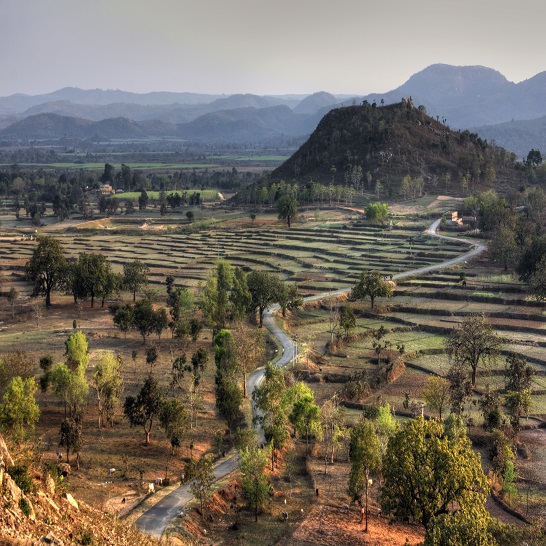
The bus breaks down exactly forty minutes outside Purulia town, and a man in a faded kurta—the conductor, though his actual job seems to involve knowing everyone's family history—tells you this happens on Tuesdays. It is, in fact, Tuesday. You step onto red laterite soil that stains your shoes immediately and permanently, the kind of dust that doesn't wash out but rather settles into the fabric like a memory. Around you, sal forests press in from both sides, their leaves the particular silver-green of late October, and somewhere in that thickness a cuckoo is calling—the same three-note phrase, over and over, as if trying to teach you something important but giving up halfway through. The air tastes of wood smoke and the specific mustiness of earth that hasn't seen rain in three weeks. Nobody is in a hurry. The conductor sits cross-legged on the roadside, chewing betel leaf, and when you ask how long the repair will take, he says, "Beta, the engine has decided to rest. We should respect its decision." This is Purulia in a single moment—a place where mechanical failure is treated as a philosophical event.
The town itself is built around a story nobody tells anymore, but the buildings remember. Walk past the Jagannath Temple on Station Road and you'll find yourself in front of a structure so thoroughly terracotta it looks like it's made from compressed sunsets—the brick work, the carved door frame where peacocks are frozen mid-dance, the small chamber where a priest named Subrata (who has been there for thirty-two years and makes the best luchi in three districts) told me about the annual Chhau dance festival that happens every spring. "Not the famous one from Purulia district that tourists know," he said, pressing warm jaggery into my palm. "The real one, the one the villages do for themselves, in the courtyards and on threshing grounds where nobody is watching." The Chhau, he explained while we drank impossibly strong chai, is a masked dance-drama that comes from the hills—part tribal ritual, part story, mostly magic—and every family in Purulia carries it like a secret passed down through muscle and shadow. These dances used to be performed by young boys and men from the region's scheduled castes, and though that has changed, the DNA of it remains: movement that speaks what words cannot, stories about gods and demons told by people whose bodies have learned to become vessels.

The real Purulia reveals itself not at landmarks but at mealtimes. Find yourself at a tea stall called Dey's (there are seven tea stalls called Dey's, but locals know which one you mean), and order the luchi-aloo—puffed bread with spiced potato that costs twenty rupees and will feed you better than a five-star breakfast. The woman making it, Ruma Dey, has been doing this for twenty-four years, and she knows by sight which customers want extra turmeric and which want their potatoes almost burnt. She'll also insist you taste her special khichdi-momos—a Purulia hybrid that exists nowhere else, steamed dumplings stuffed with rice, lentils, and vegetables, served with a chutney that tastes like it was assembled from the forest floor itself. "I invented them," she says matter-of-factly while flipping luchi with her bare fingertips in 200-degree oil. "My husband said nobody would eat them. Thirty thousand people have eaten them." The market around Purulia Station smells like marigold, cardamom, and the particular funk of dried fish that the old Bengali women are buying for a specific kind of curry that requires exactly seven ingredients and three hours. This is where Purulia tastes like itself—not in restaurant recommendations but in the meals that don't have names because they've been made the same way since someone's grandmother decided they should be.
Here is what you need to know before you go, the kind of wisdom that comes from walking into the wrong hotel twice and learning. First: don't expect boutique. The guesthouses in Purulia are clean and honest, with the kind of WiFi that works during monsoon and fails during sunshine, which is backwards but accurate. The real stay is at someone's home—contact the local tour operators (Google "Purulia local guides" and call the first number, which will be someone's personal mobile) and they will arrange a homestay with families who have actually decided they like foreigners, not just need the money. Second: the bus from Kolkata takes five hours if traffic cooperates and six if it doesn't, which is most of the time. Book tickets the day before. Third: November to February is the only season that makes sense—the humidity dies, the light becomes amber-gold, and the forests stop trying to murder you with their wetness. July to September will test your willingness to be permanently damp. Fourth: don't ask for the "Chhau festival" and expect it to be convenient. It happens in spring on dates that shift every year because the villages decide when the dancing will happen, not a government calendar.
What actually draws people back to Purulia—and I mean the people who've been twice, who carry it in their chest the way some people carry photos—is the Ajodhya Hills. These aren't mountains so much as the earth's way of saying, "Wait, let's try this again." Laterite cliffs the color of old blood rise abruptly from the plains, covered in scrubland and eucalyptus, and if you climb them at dawn (the local guides insist on this, and they are right), you emerge at the top to find yourself completely alone in a landscape that feels prehistoric—stone, sky, and the specific sound of wind moving through rock that hasn't been shaped into anything useful. The people of Purulia walk these hills like other people walk gardens. There are ancient caves, some with tribal markings that are centuries old, some with names that locals disagree about entirely. One evening I sat at the base of a cliff with a guide named Ravi, and he pointed to a cave and said, "That one, we don't go into anymore." When I asked why, he said, "Because the mountain asked us not to," and when I pressed further, he smiled and changed the subject in a way that suggested this was a conversation between him and the earth that I was only pretending to understand.
But Purulia's real gift is the way it treats loneliness as something valuable. The landscape is sparse—red earth, scattered settlements, long stretches of nothing that don't feel empty so much as full of silence. You'll walk for an hour and pass maybe two other people, both of whom will greet you with that particular Bengali warmth that exists somewhere between curiosity and kinship. The tribal villages in the surrounding districts (Raghunathpur, Manbazar) have their own rhythm, their own economy of exchange that has nothing to do with money as tourists understand it. If you go with permission and genuine interest, people will show you how they make the beautiful bell-metal work for which Purulia was once famous, or how they cultivate the red rice that tastes completely different from regular rice because the earth here insists on it. These aren't performances. Nobody is trying to be authentic for you. They're simply living in the way their families have lived, and if you're lucky and quiet, they might let you sit nearby while they do it.
The thing about Purulia is that it doesn't change you in the dramatic way some places do. It doesn't crack you open or give you epiphanies at sunset. Instead, it settles into you like that red dust on your shoes—slowly, quietly, permanently. Months after you leave, you'll smell wood smoke or see light hit red earth at a particular angle, and you'll miss it with a specificity that's almost embarrassing. You'll remember the taste of Ruma's khichdi-momos, the sound of Ravi saying the mountain asked us not to, the moment the conductor philosophized about the engine's need for rest. You'll want to go back not because you missed something but because Purulia somehow convinced you that the world makes more sense when you're there. If this has sparked something in you, the team at Dream Destiny Trips has a tendency to turn these sparks into actual itineraries—reach out and watch what happens.