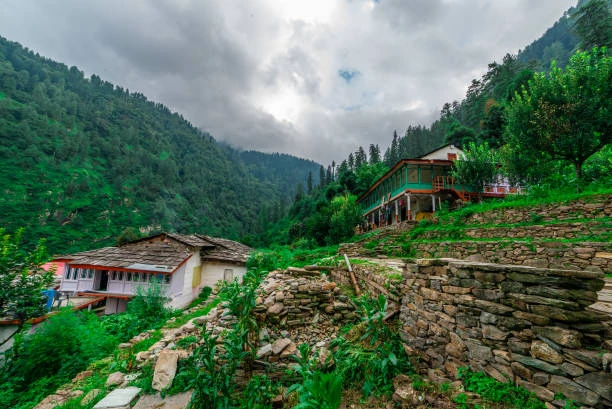
The bus lurches around a hairpin turn and for a moment—just long enough to make your stomach flip—you can see nothing but sky. A conductor with seventeen years of experience and a cigarette balanced on his ear navigates these roads the way most people walk to the kitchen. The Himalayas don't announce themselves with drama when you're this close; they simply surround you, layer after layer of granite and pine, until you stop thinking of yourself as separate from them. Below, a prayer flag snaps in wind that smells like woodsmoke and rain about to happen. The towns you've come to find—Shimla, Kullu, Manali—aren't destinations so much as they are waypoints where the mountains have agreed to let humans build small things. You realize this within the first hour: you haven't come to see these places. You've come to be seen by them.
Shimla was built by the British as an escape from Delhi's heat, and you can still feel the colonial ghost in the wood-panelled hotels and the toy train that wheezes up and down the ridge like something from a children's storybook. But what the guidebooks don't tell you is that Shimla belongs to its old women now—the ones who sit on their balconies overlooking the bazaar, watching tourists and locals navigate the toy train's schedule as if it were a matter of profound importance. There's a woman named Parvati who runs a small dhaba on the Mall Road, the main bazaar street that winds through the town's heart. She's been there for thirty-eight years, and she'll tell you—if you sit long enough with your tea—that the real Shimla isn't in the photographs. It's in the off-season, November through February, when the tourists thin out and the town remembers itself. She remembers when Shimla was a place where people lived, not where they visited. Her dal makhani tastes like that memory.
The market smells different in each town, and this matters more than anyone admits. Shimla's bazaar smells like cardamom and old money—there's a sweetness underneath that's almost floral. Kullu, an hour further down the road, smells like river water and wool. The weavers here have been making shawls for generations, and if you walk through the old town in the early morning, you'll see women at handlooms in tiny shops, their hands moving with the kind of rhythm that only comes from muscle memory spanning decades. The prices tourists pay for these shawls would make a local weaver laugh and weep simultaneously. But keep walking, past the main bazaar, down towards the river, and you'll find families still selling directly—ask for 'pashm' and watch the expression on their faces change. In Manali, the smell is pine sap and dung fires and something else—possibility, maybe, or the particular loneliness of a place that's trying very hard not to become a theme park. The markets here are louder, younger, full of Israeli backpackers and Instagram-famous cafes. There's nothing wrong with this, but it's important to know what you're walking into.

Here's what nobody tells you before you arrive: the five-hour bus ride from Shimla to Manali will test your faith in suspension systems and your relationship with nausea. The WiFi in most guesthouses won't work during monsoon. You'll meet vendors who are aggressively friendly, and you'll have to develop a polite way to say no that doesn't destroy their day. The altitude will give you a mild headache your first night—drink water, eat lightly, and don't rush. Go in October or November, or March through early May. December through February brings snow that's glorious but can strand you, and June through September is monsoon season when landslides close roads and your hair becomes a cloud. The real travellers? They go in shoulder seasons, when the light is golden and the crowds have the good sense to be elsewhere. Skip the touristy restaurants and eat where the bus drivers eat. That's not romantic advice—that's just where the food is actually good.

Between Shimla and Kullu, there's a stretch of road where the landscape does something that photographs can't capture—it opens up suddenly, and you realize you're driving through something that feels older than time. This is where you stop believing in the distance between earth and sky. Kullu itself is where the valley floor allows breathing room, and the Beas River moves through it like the town's quiet heartbeat. If Shimla is colonial nostalgia and Manali is adventure-tourism energy, Kullu is something stranger—it's a place that hasn't quite decided what it wants to become. This indecision is its gift. You can actually wander here without feeling like you're following a predetermined route. Walk across the old bridge near the bazaar at dusk and watch the light change the river's color four times in as many minutes. Sit with a local tea vendor and ask him about the Dussehra festival that happens here each October, when the valley fills with music and the effigies of Ravana are burned in a celebration that's been happening for centuries. These aren't tourist moments. These are the moments that happen when you have the luxury of being slightly lost.
Manali is where most people end up, and where the three towns reveal their relationship to time. This place has been loved almost to death by travellers, but venture beyond Old Manali—past the row of cafes named 'Everest' and 'Himalayas'—and you'll find a version that still breathes. Take the forest trail towards Bhrigu Lake, an afternoon's hike that ends with a high-altitude lake that feels like a private audience with the mountains. Or sit in the Vashisht Baths, where hot springs still emerge from the earth, and understand that this landscape has been sacred long before anyone thought to turn it into a destination. The Old Manali bazaar itself is worth an hour of your time—not for shopping, but for the absurdity of wandering through a Indian mountain town where someone is trying to sell you both momos and macadamia nut cookies. A tourist once showed up here in a three-piece suit, having misread the elevation as something manageable. He lasted forty minutes before the altitude and the stairs defeated him. The locals were kind about it.
When you finally leave—and you will, because that's what happens with places this alive—you'll carry something back that doesn't fit into any suitcase. It's the sound of a bus horn echoing off a canyon wall at dawn. It's the taste of Kullu trout grilled with lemon. It's the specific weight of mountain cold on your face at 3 AM when you stepped outside for reasons you don't quite remember. It's the feeling of having been in a place where you were genuinely small, and how strangely comforting that was. The mountains don't care if you return, but they also don't forget you. And somehow, that paradox—being completely unimportant and completely seen at the same time—is what will pull you back. If this has sparked something in you, the team at Dream Destiny Trips has a tendency to turn these sparks into actual itineraries. Reach out and watch what happens.