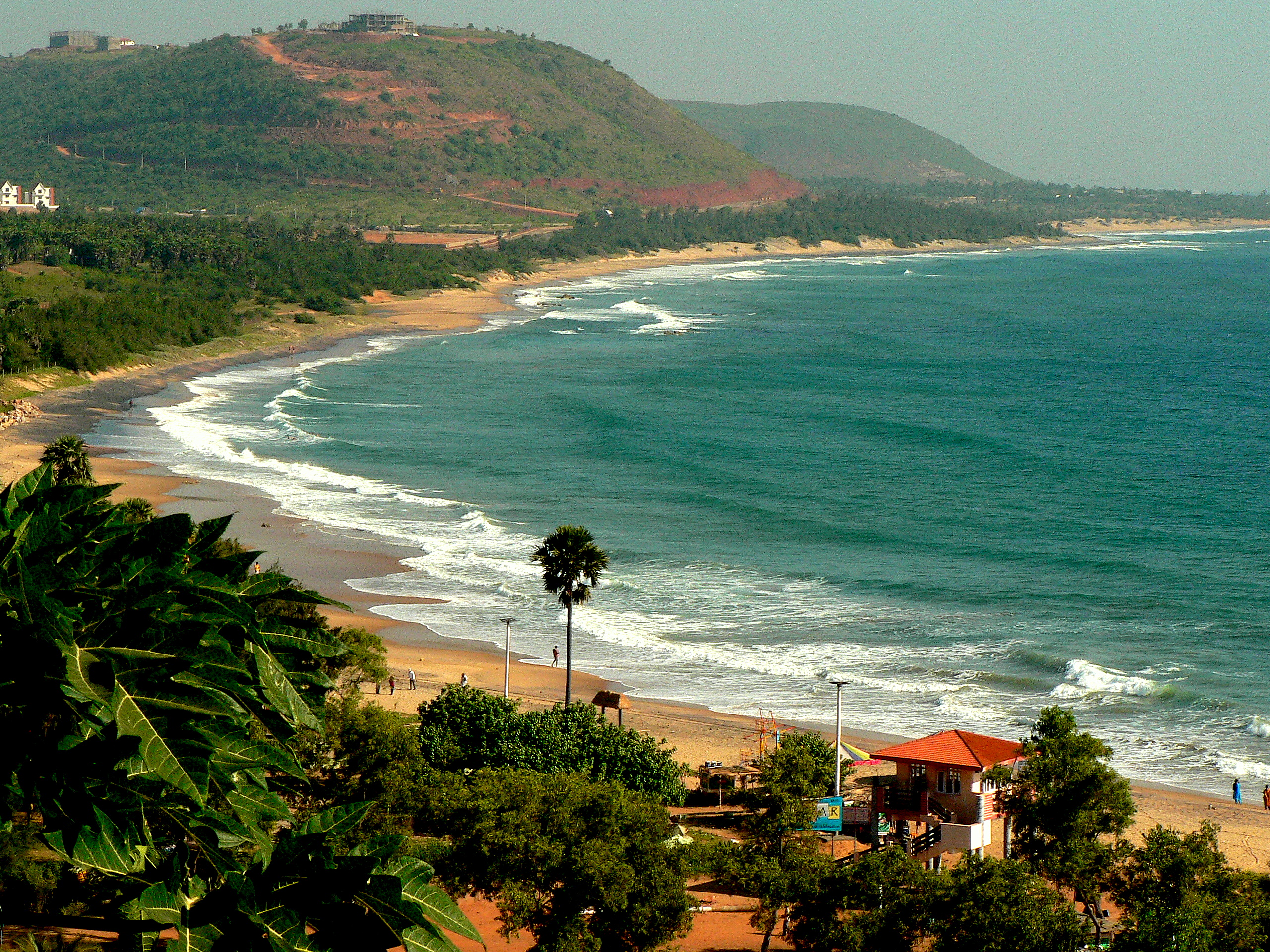
The bus lurches around a corner, and suddenly you're in Vizag proper—diesel fumes meeting salt spray, the port sprawling below like something drawn in rust and rope. It's 6:47 am. A man in a vest is pouring chai from a height of about two feet into a small cup without spilling a drop, and you realize you've just watched a small miracle. The Beach Road stretches north, lined with coconut palms that lean into each other like old friends, and the Arabian Sea is the colour of pewter turning to gold. Nobody tells you that Vizag's first gift is light—the way it hits the water before it hits the land, the way it makes the city look unfinished, like something still being decided. Three fishermen are mending nets on the sand, their hands moving in rhythms their grandfathers probably taught them. A tourist in a full suit (full suit, on a beach, in July) walks past them staring at his phone. You smile because Vizag doesn't care what you wear or whether you notice her—she's too busy being herself.
The city has been too many things to too many people, which is probably why it feels so comfortable with contradiction. Walk past the Submarine Museum—yes, an actual submarine you can descend into—and you're stepping over stories that go back to when this was a British garrison, then a Japanese-occupied port during World War II, then something being rebuilt by independent India with the kind of urgency that builds steel plants and fishing fleets. But the real history isn't in the landmarks. It's in the fisherwomen you'll see at 5 am, their baskets already full, moving through the pre-dawn darkness with the kind of certainty that comes from doing the same thing for forty years. One of them, when you fumble your Telugu and ask her name, says "Lakshmi" and laughs because of course her name is Lakshmi—goddess of prosperity, except she's real and selling fish and wearing a saree in faded purple that's been washed so many times it's almost silver. She tells you (through a mix of Telugu and hand gestures that transcend language) that the best fish come in May, that tourists never come at the right time, and that you should come back when monsoon has just finished because that's when the sea gives its best. She's not being romantic. She's being practical. The sea, for her, isn't a metaphor—it's her ledger, her calendar, her life insurance policy all at once.

But you can't talk about Vizag without talking about Araku, and you can't really understand Araku until you've sat beside someone eating lunch from a steel container. The journey between them takes five hours by bus, though it feels longer because you're climbing—genuinely, slowly climbing—from sea level into a world of coffee plantations and mist. The bus is packed with schoolchildren, housewives with shopping bags, a man with a rooster in a woven cage, and a conductor who speaks three languages and yells all of them. Somewhere around the fourth hairpin turn, you stop at a small dhaba, and the owner—a woman named Priya who has run this place for seventeen years—makes you something called jungle biryani, which is not biryani at all but layers of rice and whatever the forest gives you that day. It tastes like smoke and cardamom and the kind of honesty that cities have forgotten. By the time you reach Araku Valley, you understand why people come here to die slowly, peacefully, without any fuss. The air is thinner. Your breath changes. Coffee grows in the shade of tall trees, and the locals (the Adivasi communities who've lived here for centuries) have a saying: "chai pe charcha"—tea-time gossip—where entire life philosophies get debated over steaming cups. You sit in a small homestay, drinking coffee that was picked that morning, and suddenly the real world feels very far away. Not peaceful-far, not spiritual-far. Just genuinely far, the way distance feels when you've actually earned it.
Here's what the guidebooks won't tell you: avoid Vizag during May and June unless you have a high heat tolerance and the personality of someone who enjoys sitting in soup. The monsoon (June to September) is magnificent if you don't mind the rains, and October through February is when everyone and their cousin's travel agent shows up. The sweet spot is March and April, when the weather is kind, the port is active (so you get the life-energy), and Araku isn't yet crowded with college groups looking for Instagram moments. Skip the usual circuit of temples and monuments—you'll see them, sure, but they're not why you're here. Instead, find a local guide in Vizag who actually lives there, not someone with a script. Pay them properly. Let them take you to the neighbourhoods where they eat, not where tourists are supposed to want to be. In Araku, don't book the resort. Book a homestay. The difference between staying in a homestay run by an Adivasi family and staying in a "luxury" property is the difference between being a visitor and being someone's guest. Also: the WiFi will be unreliable. Embrace this. It's a feature, not a bug. And when someone offers you homemade rice beer, you drink it, smile, and make a new friend—that's the deal.

The train ride from Vizag to Araku is worth taking at least once, though only if you have time and patience. It's not fast or particularly comfortable, but the route itself is a work of engineering poetry—35 tunnels carved through mountains, 88 bridges spanning valleys that would otherwise be impassable. On one particular journey, a woman across from you is traveling with her grandson, and she's explaining (in Malayalam, which you only half-understand) the history of every bridge, every tunnel, like she's reciting family genealogy. She points out where there was a derailment in 1987, where her cousin used to work as a porter, where a landslide took out the tracks for six months. The landscape becomes personal. The journey becomes a conversation. This is what Vizag and Araku teach you over time—that places are most alive when someone who loves them tells you why.
Araku's real treasure is its coffee, but not in the way you might think. The coffee plantations here use something called the "shade-grown" method, which means the coffee plants grow under taller forest trees, creating this multi-layered ecosystem that's as old as the mountains themselves. You can visit plantations, yes, but better is to walk through them without a plan, sit under a tree, and drink coffee that a planter hands you from their personal flask. The bitter-sweet clarity of it, the lack of pretense, the simple fact that you're drinking something someone grew with their own hands—it realigns something inside you. There's a waterfall called Ananthagiri Falls that most tourists see in fifteen minutes and leave. Go earlier, stay longer, and you'll see it differently—the way the mist clings to the rocks, the impossible green of the ferns, the small cave behind the water where pilgrims used to sit. You might be alone there. This is when Araku reveals itself completely.
Weeks after you've left, when you're back in your city and the monsoon is just beginning somewhere else, you'll find yourself thinking about the taste of that jungle biryani, the sound of the bus conductor yelling station names, the way Lakshmi laughed at you. You'll think about how Vizag doesn't try to be anything other than what it is—a working city with a port, with fishermen, with salt and stories—and how Araku taught you that slowness isn't the opposite of living, it's the truest version of it. You'll realize you're already planning to go back, that these places have become the kind you carry with you. If this has sparked something in you, the team at Dream Destiny Trips has a tendency to turn these sparks into actual itineraries—reach out and watch what happens.