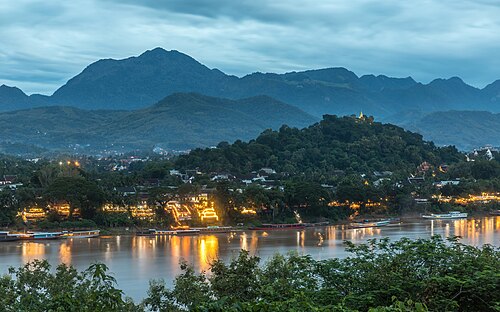
The alarm on your phone says 5:47 AM. You ignore it. By 5:52, you're walking through streets still damp from the night rain, past shuttered shop-houses painted the colour of old butter, their wooden shutters breathing slowly in the pre-dawn air. Incense smoke curls from a dozen doorways. The Mekong hasn't woken up yet—it's still grey, still thinking about yesterday. Then the bells begin. Soft at first, like someone testing a song they haven't sung in years. By the time you reach the monastery steps, there are already three dozen of you standing in the half-dark, foreigners and locals mixed, everyone understanding the same wordless instruction: be quiet, be still, watch what happens when a town says its prayers in saffron robes and bare feet.
The first time I stayed in Luang Prabang—which sounds like a travel brochure lie, but stay with me—an elderly woman named Khamphoui who ran the guesthouse asked me why I wasn't at the morning alms walk. I said I'd come back for it tomorrow. She looked at me the way you'd look at someone who told you they'd visit the beach tomorrow instead of today, and then she did something that changed the rhythm of my entire trip: she woke me up at 5:30 the next morning with sweet tea and a small basket of sticky rice. No lecture. No dramatics. Just: this matters, come. That's when I understood that Luang Prabang isn't teaching you about Buddhist ritual or French colonial history—it's teaching you something more basic and more difficult. It's teaching you that there are some things you don't defer. That some mornings are different from other mornings. That a town built on the principle of 'baat' (the act of giving alms, but also the whole philosophy of daily generosity) works on a timeline that has nothing to do with your itinerary.

By day three, you'll eat at a wooden shack near the night market where a man named Siphouttharath has been making khao soi (that gorgeous golden curry noodle soup, the kind that tastes like someone cooked warmth into a bowl) for thirty-two years. He won't have a sign. You'll know it's the right place because there will be locals sitting on plastic stools at 7 PM on a Thursday, which is the universal language of 'the food here actually matters.' Order the Luang Prabang version—they add crispy egg noodles and a squeeze of lime that makes you understand why people write poems about food. The vendor next to him, a woman who sells sticky rice in bamboo containers, will try to give you extra when she finds out it's your first time. 'Sab-bai-dee' you'll say—stay happy—which is both a greeting and a philosophy, and she'll laugh because you pronounced it like you had a small stone in your mouth, but the effort counts in this town. Everything is an effort to be gentle with each other.
Here's what nobody tells you: the WiFi in most guesthouses is a suggestion, not a guarantee. The bus to the 4,000 Islands stops when the driver decides to stop, which may be never, which may be at a random house where someone's cousin sells papaya. The French colonial architecture is stunning until you realize it's crumbling and under-resourced, which makes you love it more, not less. Skip the main tourist trail on Sisavangvong Road and take your coffee to the small lane behind Wat Xieng Thong monastery instead—it's wide enough for bicycles and narrow enough that you'll actually see how people live here. The best time to visit is November through January, when the nights are cool enough to actually sleep, the rains have stopped making everything stick to everything else, and the Mekong is low enough to expose its sandbars. Go at any other time if you need to, but understand that you're making it harder for yourself.
There's a waterfall called Kuang Si that everyone will tell you about, and the reason they tell you is legitimate—the water is that implausible blue, the kind of blue that makes you check if your phone camera is playing tricks on you. But here's what matters: go at opening time, when the locals are still there and the tourists are still eating breakfast. Swim in the lower pool if you're confident. If not, sit on the rocks and watch the water negotiate its way down limestone cliffs that have been doing this same thing for longer than written history. There's a small rescue animal sanctuary nearby—rescued sun bears, mostly—and the sight of a bear being gentle, after seeing what captivity does, will break something open in you that you didn't know was closed. The walk up is muddy and steep and your shoes will regret it entirely, but the French colonial part of you (every visitor to Luang Prabang develops one) will accept this as the price of beauty.
You'll probably take a boat on the Mekong at some point. Do this at sunset, not because the guidebooks tell you to, but because that's when the fishermen are actually working—you'll see the great wooden boats with their nets shaped like enormous spoons, and you'll understand that this river has fed this town since before anyone wrote down its name. The light will turn the water the colour of caramel. You might see fishermen using elephants—actual elephants—to drag nets, which feels like you've fallen into a century you were born too late for. The boatman will smoke cigarettes and won't try to sell you anything, and that restraint will feel like kindness. Stop at one of the fishing villages if you can, the ones where houses float on bamboo and children wave from doorways. Don't buy anything. Just witness that people live like this, still, in a way that makes your apartment back home feel like science fiction.

When you leave Luang Prabang—and you will, the bus will eventually come, the WiFi will finally connect long enough for you to book your flight out—you'll carry something back that no souvenir captures. It's not the temples or the French shutters or even the food, though those are all real. It's the peculiar ache of having spent time somewhere that doesn't need you to achieve anything. The town asked you to show up and sit still and pay attention, and somewhere around day five, you stopped checking your messages and actually did it. You'll think about Khamphoui's morning tea for weeks. You'll crave that khao soi at random moments. You'll realize that 'baat' has burrowed into how you think about generosity now. Back home, in the noise and the rushing, you'll miss the sound of those monastery bells and understand, for the first time, why people talk about places like this the way other people talk about love—not as a tourist attraction, but as something that changed their internal weather. If this has sparked something in you, the team at Dream Destiny Trips has a tendency to turn these sparks into actual itineraries—reach out and watch what happens.