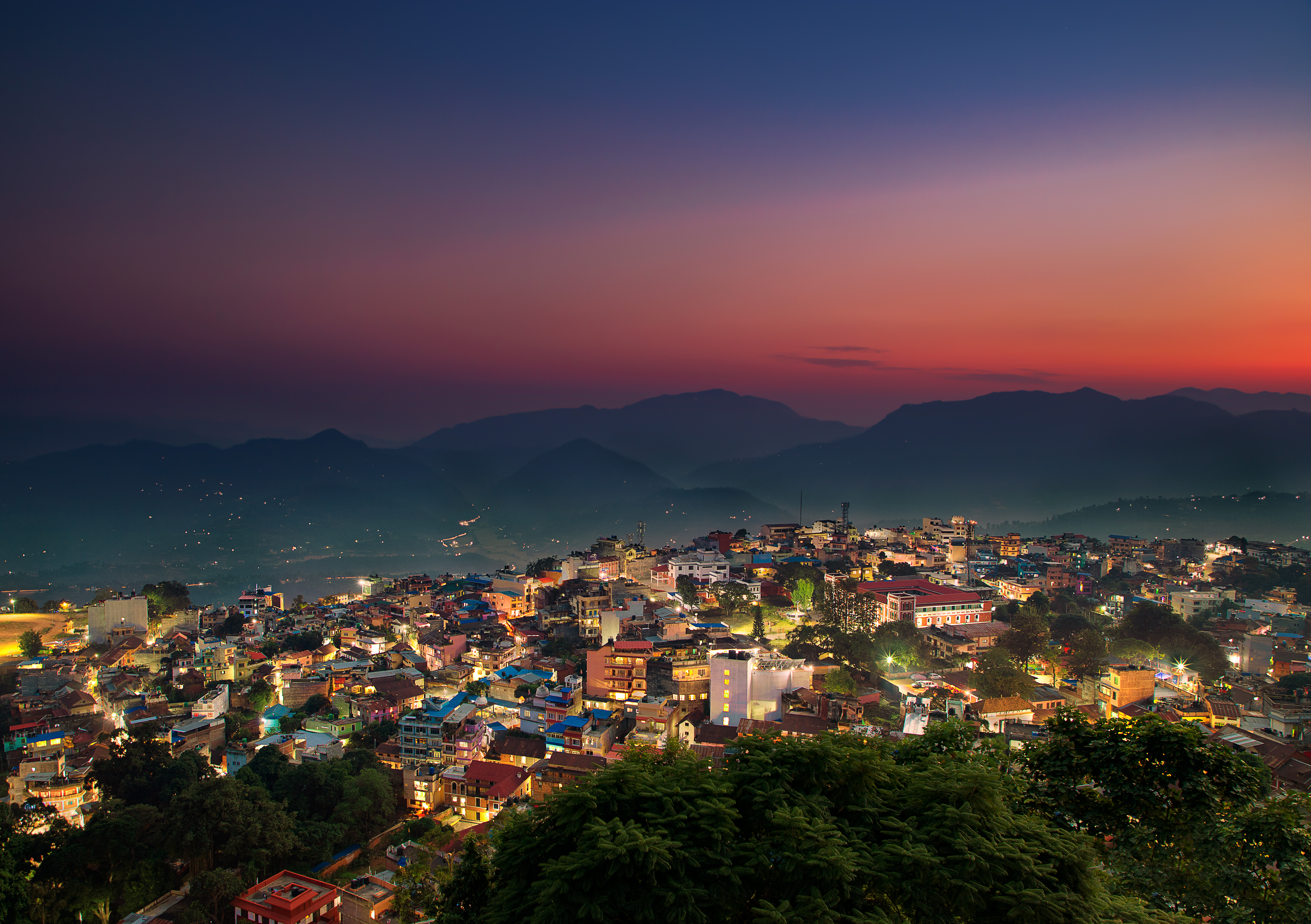
The bus conductor hasn't slept. You know this because he's been chain-smoking cigarettes he rolls himself since 4 a.m., and it's now 7 a.m., and you're somewhere in the foothills where the road is negotiating with gravity and losing. The mountains here don't announce themselves—they just exist, solid and indifferent, while your stomach does acrobatics and a woman next to you is eating a boiled egg with her fingers and somehow it smells like home, even though you've never been here before. This is Nepal in its most honest form: not the postcard version with prayer flags and perfectly lit stupas, but the real version where nothing quite works, everything smells like wood smoke and diesel, and somehow you feel more alive than you have in months. The light hitting the valley walls is pale gold and slightly grainy, like old film stock, and you realize with a jolt that you're not thinking about your email. You're thinking about whether that vendor at the last stop was selling momos or dumplings, and whether there's a difference.
Fifteen years ago, my guide Hari lost his father on a mountain that didn't have a name, just a number on a trekking permit. The old man had been a Sherpa—the actual carrying-loads kind, not the guide kind—and he died doing what he'd always done: hauling someone else's dreams to altitude. Hari doesn't talk about it much, but last year when we were sitting outside a monastery in the Langtang Valley, waiting for tea, he told me something that rewired how I understand this place. He said his father never complained about the mountains. Not once. Even when his lungs were failing and his knees were argument-prone and younger men were moving past him on the trail. Hari said the mountains had taught his father something: that some things are bigger than your small suffering, and accepting that is what keeps you moving. That philosophy sits underneath everything in Nepal—it's in the way porters never curse at switchbacks, in the way locals joke about power cuts instead of raging, in the way a shop owner will give you chai even if you're obviously a lost tourist who can't speak Nepali. The mountains aren't metaphors here. They're the thing itself.
You will eat momo—the dumpling, steamed and pleated like tiny origami—at a place that doesn't have a name, only a woman named Tara who cooks them in a courtyard behind a spice shop in Thamel. They cost maybe 30 rupees for four, and they're filled with potato and onion and something she won't name because it's family recipe, na? The dal bhat—lentil soup and rice, the everyday meal that locals eat at lunch and dinner—is also the most subversive thing about Nepal because it's so simple and so complete that it ruins you for fancy food for about three weeks. There's also raksi, the local moonshine that tastes like someone fermented regret and bottled it, and if a local offers you some, accept it and pretend it tastes like anything other than what it does. But the real soul food is chiya—the tea, strong and sweet and made with cardamom and ginger and milk that's probably not super fresh, which somehow makes it taste better. You'll see groups of old men doing chai pe charcha—literally 'tea and talk,' gossip and philosophy mixed together—and you'll want to join them even though you don't speak the language. These moments, the accidental ones where you're just sitting and eating and being, are the ones you'll carry home.

Here's what nobody tells you: the WiFi is abysmal, the water quality is unpredictable, and the bus from Kathmandu to Pokhara will make you question every life choice that led to that moment. Also, the tourism industry here hasn't figured out the art of saying no—if someone asks you to trek with them, hire them as a guide, stay at their relative's guesthouse, the word 'no' gets lost somewhere between politeness and desperation. You have to get comfortable being firm without being rude, which is harder than it sounds. Go in October or November, when the mountains have just cleaned themselves of monsoon clouds and visibility is almost obscene—you can see forever and it feels like a privilege. Avoid March and April unless you like hiking in haze. And here's the insider thing: skip the main drag of Thamel if you want to actually meet Kathmandu. Instead, go to Panauti, a town 40 kilometers away that has an ancient brick bazaar, zero tour buses, and locals who will actually talk to you because they're not tired from talking to tourists all day. The people there still do the old things the old way—you'll see women spinning wool, metalworkers hammering in the same courtyards their great-grandfathers worked in.
The trekking gets written about too much, so let me tell you about the walking instead. Walking in Nepal isn't about summiting—it's about rhythm. You fall into the pace of your own breathing, the click of your poles, the pattern of your boots on stone steps that are sometimes a thousand years old. You walk through rhododendron forests so thick they feel like cathedral, through villages where electricity is still something that happens sometimes, where children learn English from tourists and YouTube and end up speaking it with this charming, slightly formal precision. You walk past prayer wheels spinning in the wind and think about intention, about the idea that every rotation is a prayer released. And sometimes you sit by a window in a teahouse at 10,000 feet and watch the clouds move below you, and you understand something about perspective that no gym class or meditation app could teach you. The mountains here aren't sublime in the way people write about them in brochures. They're intimate. They're company.
But Nepal also breaks your heart, if you let it look you in the eye. The earthquake of 2015 still lives in the rebuilt temples where you can see new wood next to ancient, in the careful reinforcements underneath heritage sites. You'll meet people who lost everything and rebuilt on the same plot of land because it's theirs and it's home. You'll see how quickly a country can be forgotten by the international news cycle, how a disaster becomes a past tense story for people who never experienced the actual debris. And you'll feel a little bit guilty for being there as a tourist, for getting to leave, for getting to turn this into a story. That's the part that makes you real—that discomfort, that awareness that your travel adventure is someone else's daily reality with its actual fragility and fear.
When you leave Nepal, you'll find yourself thinking about it at odd moments: waiting for your flight home, standing in a supermarket with forty types of cereal, sitting in a meeting where people are arguing about metrics. You'll miss the simplicity, the way a conversation can happen over tea with no agenda, the feeling of being genuinely lost and finding it funny instead of stressful. You'll miss the mountains most—not for their beauty, though they have that, but for the specific humbling they provide. If this spark of recognition, this sense that you need to go back and sit properly in this place, has kindled something in you, reach out to the team at Dream Destiny Trips. They have a particular genius for building itineraries that skip the obvious things and land you in the moments that actually matter—the ones where you'll come home changed.