The marshrutka driver is honking at a man selling roasted corn on Shardeni Street, and you understand nothing except that Georgian men can have arguments about absolutely anything, anywhere, at any volume. Tbilisi hits you like that—not with a postcard moment, but with the sound of a city that doesn't perform for tourists, a place where sulphur baths steam invisibly beneath crumbling 19th-century facades, where old men play backgammon in wine cellars that smell like centuries, and where someone will absolutely insist you try their homemade chacha (grape brandy that tastes like it could dissolve your teeth) at 10 in the morning. The light here is particular—a kind of amber that sits between the Mtkvari River and the terracotta roofs like it's been waiting all day just to hit the old Sioni Cathedral at exactly the right angle. You've been here four times now, and you still get lost in the same three streets, and you've stopped apologizing for it.
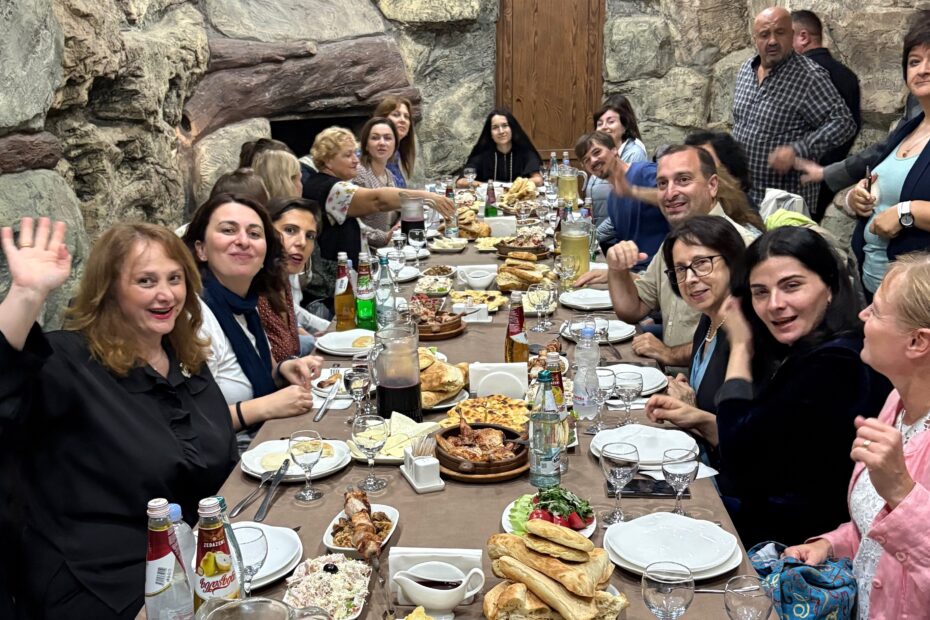
There's a Georgian word, supra, which doesn't just mean 'feast'—it means the entire philosophy of gathering, of excess, of making strangers into family through sheer force of wine and bread and argument. You learn this not from a guidebook but from Giorgi, who owns a wine shop in Vino Underground, a place so packed with bottles and old men debating natural fermentation that it feels less like retail and more like a secret society that occasionally sells things. Giorgi is 62, wears a linen shirt unbuttoned to his sternum, and has spent the last three hours explaining why Georgian orange wine (white grapes, macerated like red wine) is not, actually, a trend—it's a 6,000-year-old return to form. The Georgians invented wine, he tells you, not unkindly but as you might explain water to someone who's been thirsty their whole life. He pulls down a bottle from 2019, unmarked except for a date scratched on the cork, and pours it into mismatched glasses. It tastes like stone and honey and the kind of amber light you saw that morning. Giorgi nods. 'You understand now,' he says. You don't, entirely, but you're beginning to.
This is when you should eat khachapuri—the cheese-bread that is somehow both a religious experience and a snack. You find the best one not in the fancy part of town but on a side street near Metekhi, at a place with no sign that serves only three things: khachapuri, a salad, and whatever wine the owner decides you're having today. The woman making the khachapuri (let's call her Nana, because everyone's Nana here) has been doing this for twenty-eight years, and her hands move through the dough like they're playing an instrument only she can hear. The adjarian version arrives in a boat-shaped bread, molten cheese pools in the center, and you break a raw egg into it because that's what you do, then drag your bread through the yolk. It's criminally simple and impossibly satisfying. Around you, locals are eating the exact same thing, reading newspapers, having loud conversations about politics in a language that sounds like gravel and singing had a very passionate argument. No one looks at you. This is Tbilisi—you are welcome here, but you are not special here, and that is exactly why you'll come back.
Here's what tourists get wrong about Tbilisi: they stay in the Old Town and think they've seen the city. The Old Town is gorgeous, yes, but it's also where 47 cafes will charge you 12 lari for coffee and a very friendly smile. Instead, take a marshrutka (the shared minibus system that operates on pure faith and hand signals) heading north toward Saburtalo. Ask anyone, loudly, 'Saburtalo?'—and someone will point you toward a minibus where the conductor will shout the destination while hanging out the door. The fare is 30 tetri (about 11 cents), and the driver will take at least three unscheduled stops, and someone's grandmother will get on with a chicken in a plastic bag, and you'll understand that this is how a city actually moves. Go in September or early October—the summer heat is magnificent but punishing, and by autumn, Tbilisi wears its best light. Skip the 'Wine Down' tours and instead find a small wine bar in Vake district where locals actually drink; ask your guesthouse owner, and they will know exactly where. Politely decline anyone offering to take you to a strip club—this happens constantly, and while Georgian nightlife is genuinely wild, you didn't fly eight hours to make that particular mistake.
But Tbilisi is only half the story. The real revelation is Gudauri, a mountain town about 120 kilometers north where the Caucasus gets serious. A three-hour marshrutka ride takes you from the wine cellars and the urban chaos into something else entirely—a place where the air gets thinner, where the road climbs into what feels like the actual roof of the world. Gudauri sits at 2,000 meters, and the mountains around it aren't beautiful in the way travel writers use that word. They're austere. They're demanding. They don't care if you're moved by them. The guesthouses here are simple, warm, and run by people who've lived through wars and winters and know exactly how much tea you'll need. The town itself is unfinished in a way that feels intentional—Soviet-era apartment blocks beside new ski lodges beside the kind of simplicity that tourists haven't yet packaged into 'experiences.' You walk the main street at sunset, and the light hits the peaks in layers of blue-black and gold, and there is absolutely no one trying to sell you anything.

What Gudauri actually offers is the high-altitude hike to Sioni Church, a 10th-century structure sitting at 2,160 meters, accessible in a three-hour walk from the town center that climbs through alpine meadow and past shepherds who will wave at you from impossible angles. The church is small, asymmetrical, made of stone that's been weathered by more than a thousand years of Caucasus wind, and the view from its doorway includes what feels like half of Georgia spreading out below in geometric shades of green and shadow. There are no tourist facilities. There are no selfie sticks. There is just the sound of wind and the particular silence that only mountains have—the kind that feels like the world has finally stopped talking long enough to breathe. You sit on a rock outside the church for what feels like minutes and is probably an hour, and you think about nothing and everything simultaneously. This is the part of the trip you'll want to explain to people and never quite manage to.
When you fly back home, Tbilisi's wine stays in your bloodstream for weeks. You'll be in your Delhi kitchen, making something ordinary for dinner, and suddenly you'll remember Giorgi's face when you finally understood about orange wine, or the exact temperature of the khachapuri's cheese, or the sound of the marshrutka conductor shouting stops into the Tbilisi traffic. You'll remember Gudauri's silence—the particular weight of it, like the mountains had been waiting for you to arrive so they could finally rest. Georgia does this to people. It makes you want to argue about nothing, to feed people you've just met, to drink wine from unmarked bottles, to climb toward old churches in the clouds. If this has sparked something in you, the team at Dream Destiny Trips has a tendency to turn these sparks into actual itineraries that somehow capture this exact feeling—reach out, and watch what happens.